 Zerionwallet
 portfolio tracking
Zerion lets you inspect a public address's tokens and supported DeFi positions on supported networks without importing its private keys. The web app provides portfolio monitoring in a browser without an installation. Tracking an address gives you information about its holdings, without granting permission to move its assets.
Does tracking require control of the address?
Watch-only monitoring can follow an address you own or another public address. This includes observing a vault or hardware-wallet address without importing its signing key.
Zerion's web app also supports swaps and bridging when a wallet is connected, subject to support for the selected network and operation. A watched address alone cannot authorize those transactions.
What does a DeFi position add to a token balance?
A token balance describes tokens held directly at the address. DeFi positions describe assets involved in protocols, including liquidity-pool deposits and staked tokens. Zerion discovers supported positions automatically and lets you group holdings by protocol.
Supported position tracking also includes debts and unclaimed rewards. A debt identifies borrowing associated with a position. An unclaimed reward is distinct from a token already received into the wallet. Reading these components together gives more information than the directly held token balances alone.
Can matching token balances mean different portfolios?
In this hypothetical comparison, two watched addresses have identical directly held token balances. Only the first also has an Aave V3 lending position with an outstanding debt. Assume both addresses use networks with portfolio support and Zerion recognizes the lending position.
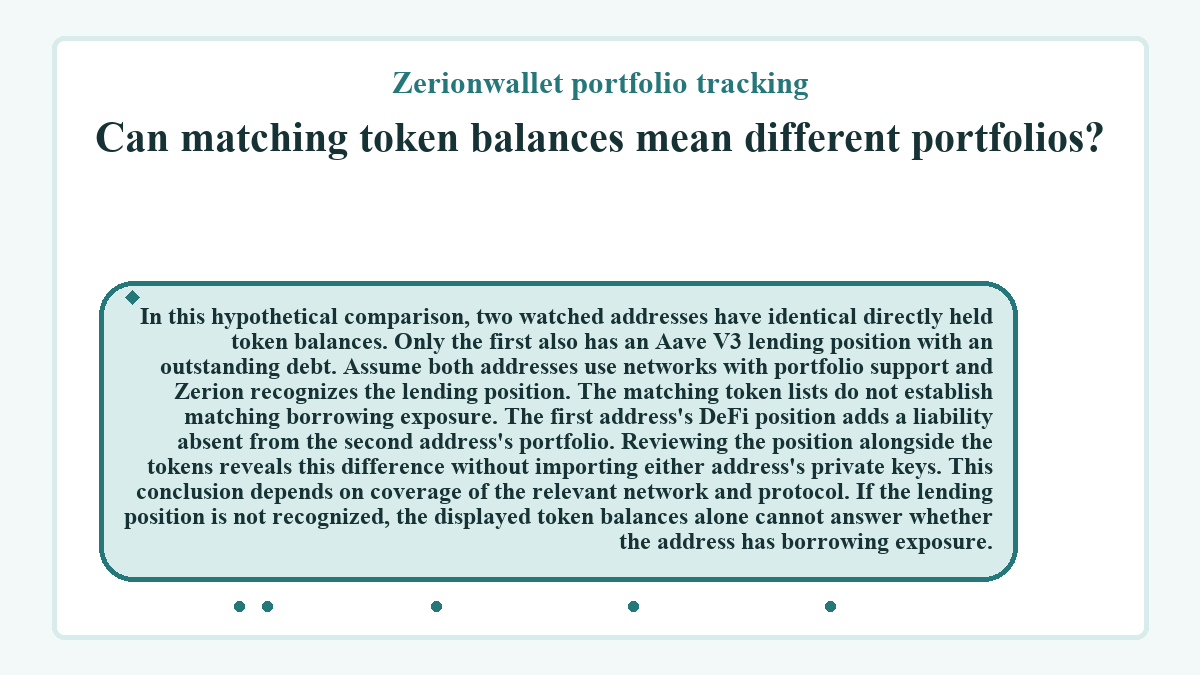
The matching token lists do not establish matching borrowing exposure. The first address's DeFi position adds a liability absent from the second address's portfolio. Reviewing the position alongside the tokens reveals this difference without importing either address's private keys.
This conclusion depends on coverage of the relevant network and protocol. If the lending position is not recognized, the displayed token balances alone cannot answer whether the address has borrowing exposure.
How does wallet activity explain the holdings?
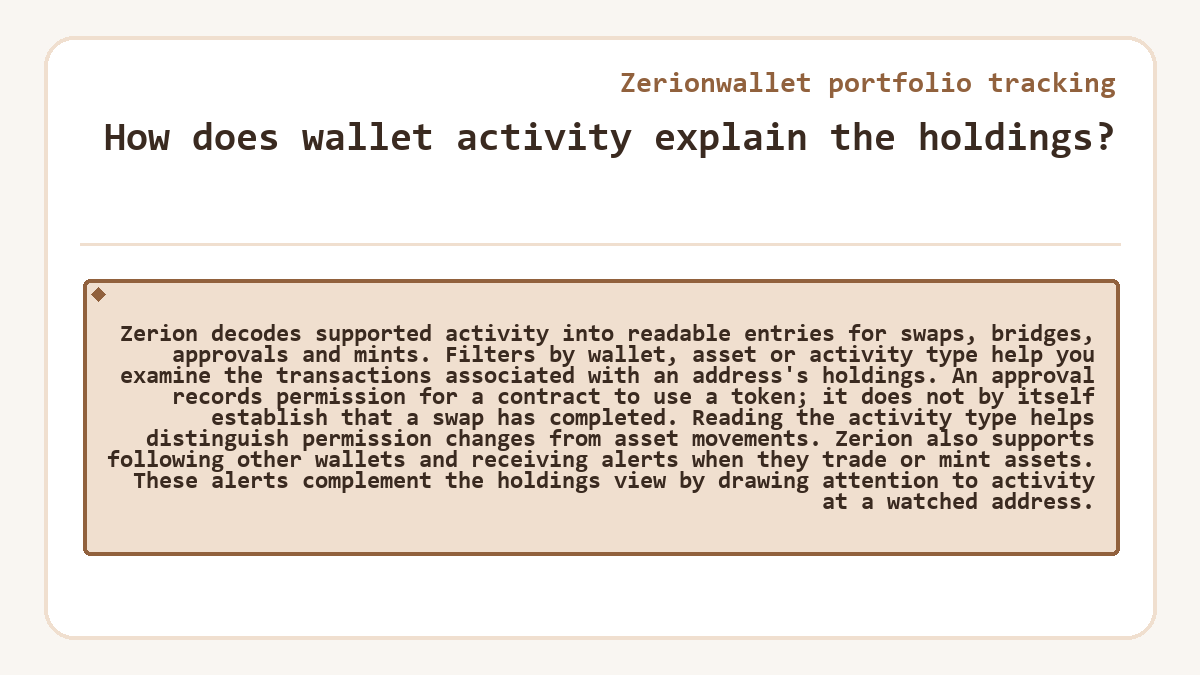
Zerion decodes supported activity into readable entries for swaps, bridges, approvals and mints. Filters by wallet, asset or activity type help you examine the transactions associated with an address's holdings.
An approval records permission for a contract to use a token; it does not by itself establish that a swap has completed. Reading the activity type helps distinguish permission changes from asset movements.
Zerion also supports following other wallets and receiving alerts when they trade or mint assets. These alerts complement the holdings view by drawing attention to activity at a watched address.
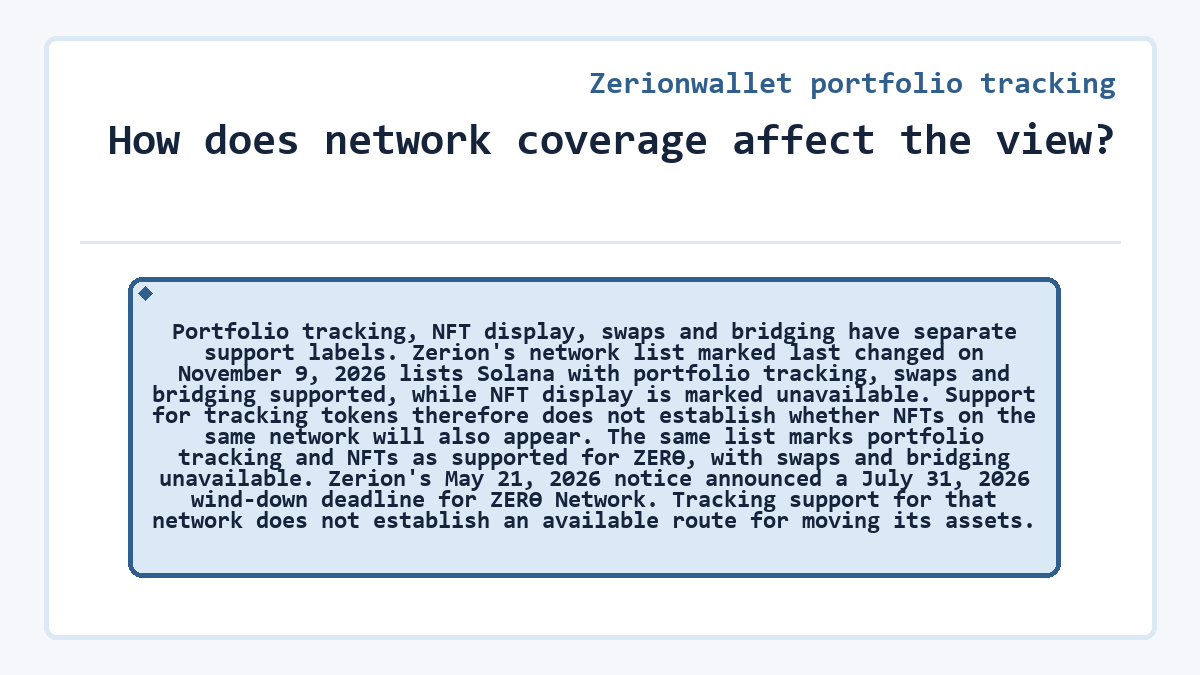
How does network coverage affect the view?
Portfolio tracking, NFT display, swaps and bridging have separate support labels. Zerion's network list marked last changed on November 9, 2026 lists Solana with portfolio tracking, swaps and bridging supported, while NFT display is marked unavailable. Support for tracking tokens therefore does not establish whether NFTs on the same network will also appear.
The same list marks portfolio tracking and NFTs as supported for ZERϴ, with swaps and bridging unavailable. Zerion's May 21, 2026 notice announced a July 31, 2026 wind-down deadline for ZERϴ Network. Tracking support for that network does not establish an available route for moving its assets.